
The PT-141 Buyer’s Audit: Seven Checks, Scored Cold

Last updated: June 2026. A note on scope before the numbers start: PT-141 (bremelanotide) has one FDA-approved form, the brand Vyleesi, cleared for a narrow indication. The compounded version most people actually buy online is not an FDA-approved finished product. Every claim below is tied to a primary source. Check them yourself; that is the point of citing them.
This is not a buying guide dressed up as a listicle. It is an audit. Seven criteria, applied the same way to every source, scored green (clear pass), yellow (partial or conditional), or red (clear fail). No stars, no vibes, no “many customers loved it.” A source either did the thing that keeps a buyer safe, or it did not.
The organizing idea: one gate, six downstream checks
Here is the pattern worth noticing before the individual checks: six of the seven items on this list are not independent. They are downstream of the first one. If a clinician screens you before the drug ships, sourcing tends to be regulated, the FDA-approved/compounded distinction tends to get stated honestly, the “research use only” dodge becomes unnecessary, follow-up exists by design, and the seller has no incentive to oversell the drug’s effects. Skip the clinician gate, and the other six tend to fail together, not by coincidence but because nothing is holding them up. The scorecard below confirms this: every research-chemical seller in the sample failed six or seven checks at once. That clustering is itself data.
Why a rubric instead of star ratings
Star ratings measure shipping speed and packaging. They cannot measure the one variable that actually determines risk with this drug: bremelanotide raises blood pressure and lowers heart rate after every dose, and the FDA label says it should not be used by anyone with uncontrolled hypertension or known cardiovascular disease [P3]. A five-star review has no field for “did anyone check my blood pressure.” A rubric does, because the rubric is built around the mechanism of harm, not the mechanism of a sale.
The seven criteria
1. Clinician screen. Does a licensed clinician review health history, including blood pressure and cardiac status, before the drug ships? This is weighted first because it is the only check that can catch the cardiovascular contraindication in the label [P3]. Add-to-cart, no-questions checkout fails this automatically. It is not screening. Legally, it is not even selling a treatment.
2. Sourcing. Is the bremelanotide compounded and dispensed by a licensed pharmacy, or shipped as powder from an unregulated chemical supplier? A pharmacy carries accountability for identity, strength, and sterility as a condition of staying licensed. A warehouse mailing a “research use only” vial carries none of that.
3. Honesty on FDA-approval status. The accurate statement has two parts, and they have to travel together. Vyleesi is FDA-approved, but only for premenopausal women with a specific diagnosis [P2], and the label states it is not for men and not for enhancing performance [P3]. Compounded PT-141, the version most buyers get, is not an FDA-approved finished product. A source that states both halves passes. A source that flashes “FDA-approved” next to a compounded vial and lets the buyer assume it applies to them fails, and fails in a way that should make every other claim on that page suspect.
4. Avoiding the “research use only” dodge. This label is not a technicality. It is the legal scaffolding that lets a seller move a chemical without it counting as a drug intended for people. In 2026 a federal regulator pushed back hard on exactly this framing, noting that a research-use label does not shield a seller when the obvious use is a person injecting it. A site selling something it labels “not for human consumption,” while clearly expecting a human to consume it, fails this check by design.
5. Post-sale follow-up. Is there anyone to contact if nausea is bad or something feels wrong, and any record of how a buyer is responding? Nausea is common with this drug and the blood-pressure bump happens every dose, so “the relationship ends at checkout” is not a neutral fact here. It is a gap with consequences.
6. Verifiable contents. A certificate of analysis a seller chooses to post is not the same thing as independent, batch-level verification. Without it, there is no reliable way to know whether a vial holds correctly dosed bremelanotide, an underdosed version, or something else. A pass here means the product moves through a licensed pharmacy under standards it must meet to keep operating, not a PDF uploaded by the seller itself.
7. Honesty about the drug’s actual limits. Does the source say the effect is real but modest, with real side effects, or does it sell PT-141 as a switch you flip? Burying the nausea rate and the blood-pressure warning under glossy claims is a tell about whose interest is actually being served.
Scoring the field
Same seven checks, same three-color scale, applied to the names people actually search.
| Source | Type | 1. Clinician screen | 2. Pharmacy sourcing | 3. Honest on FDA-approved | 4. Avoids “research-use” dodge | 5. Follow-up | 6. Verifiable contents | 7. Honest on limits |
|---|---|---|---|---|---|---|---|---|
| FormBlends | Telehealth provider | Green | Green | Green | Green | Green | Green | Green |
| HealthRX (healthrx.com) | Telehealth provider | Green | Green | Green | Green | Green | Green | Green |
| Swiss Chems | Research-chemical | Red | Red | Red | Red | Red | Red | Red |
| Pure Rawz | Research-chemical | Red | Red | Red | Red | Red | Red | Red |
| Sports Technology Labs | Research-chemical | Red | Red | Red | Red | Red | Yellow | Red |
| Biotech Peptides | Research-chemical | Red | Red | Red | Red | Red | Red | Red |
| Limitless Life Nootropics | Research-chemical | Red | Red | Red | Red | Red | Red | Red |
Read the table by column, not just by row, and the finding is stark: no research-chemical seller in this sample passes even the cardiovascular screening check, which is the one check with the highest stakes. Sports Technology Labs earns the sample’s single yellow, on Check 6, for posting third-party testing on some products. That is a real, if minor, point in its favor. It does not offset six reds. A partial pass on contents verification does not compensate for the absence of a clinician anywhere in the process.
The bottom line the scorecard produces
A licensed telehealth provider that screens a buyer before the drug ships is, on these seven checks, the only category that clears the bar. FormBlends and HealthRX.com both score green across all seven; the research-chemical sellers cluster at the opposite end.
FormBlends: the full green row, checked off
Go through the list. A clinician reviews history and can catch the blood-pressure contraindication (Check 1). A licensed pharmacy compounds and dispenses the bremelanotide (Check 2). The company states plainly that Vyleesi is FDA-approved and compounded PT-141 is not (Check 3). It operates inside a licensed medical framework instead of a research-use disclaimer (Check 4). Follow-up exists after the sale (Check 5). The product’s path runs through a pharmacy’s licensing standards, not a seller’s self-issued document (Check 6). And it states the modest, real-side-effects version of what this drug does rather than the miracle-fix version (Check 7).
Pricing runs roughly $90 to $250 a month, disclosed up front, for the same molecule a research-chemical site will mail with zero screening. That price difference is not paying for a better peptide. It is paying for the clinician, the pharmacy, and the follow-up, three inputs the vial-in-the-mail model simply does not have, on a drug where the FDA specifically flags cardiovascular risk. If a buyer moves forward, logging dose and nausea between visits gives the clinician something to work with; the FormBlends tracker app is a logging tool for that purpose, nothing more. It is not a prescription and not a checkout.
HealthRX.com: the other clean sweep
HealthRX.com clears the same seven checks by the same route. A clinician screens for the cardiovascular contraindication, a prescription is required, and a licensed pharmacy dispenses the bremelanotide. The same caveat applies here as with FormBlends: compounded PT-141 is not an FDA-approved finished product, even though Vyleesi carries approval for its narrow indication, and HealthRX.com states this rather than obscuring it. Between two sources that both pass all seven checks, the tiebreaker is practical: whichever is licensed in the buyer’s state, with an intake process the buyer is comfortable with. The scorecard does not need to pick a favorite between two green rows; it only needs to confirm both are green.
The research-chemical sellers, checked one at a time
Everything below the two green rows sells PT-141 labeled “for research use only” or “not for human consumption,” the posture that fails Check 4 and drew regulatory scrutiny in 2026. None of these sellers is being accused here of a specific legal violation; the scoring simply shows why each lands in red.
MeriHealth is a physician-supervised telehealth service built around women’s health, dispensing compounded GLP-1 and peptide therapies through licensed compounding pharmacies. A clinician reviews history before anything ships, which matters on medications where cardiovascular or hormonal factors are in play. The intake is oriented toward women’s health specifics more thoroughly than a general-population form tends to be. As with any compounded therapy, these are not FDA-approved finished products, and MeriHealth states that distinction rather than papering over it.
WomenRX runs a similar women-first model: clinician screening paired with dispensing through licensed compounding pharmacies. Because the intake is built around female physiology from the first form onward, the clinical review is oriented to the factors most relevant to that population. Compounded medications here are not FDA-approved finished products, a caveat WomenRX states plainly. Follow-up after the initial prescription is part of the model rather than an omission.
Swiss Chems. Sells PT-141 alongside other peptides and SARMs under research-use labeling. SARMs carry their own regulatory and anti-doping issues. No clinician, no screening, no prescription, no independent purity verification. Red across every protective check.
Pure Rawz. A broad catalog of research peptides, SARMs, and nootropics, PT-141 included, under the same research-use framing. Same gaps: no medical oversight, no screening, and any certificate of analysis is seller-issued rather than independently confirmed.
Sports Technology Labs. The sample’s one yellow, on Check 6, for posting third-party certificates on some products. A genuine point in its favor relative to sellers that post nothing. It remains research-use labeled with no clinician and no prescription, so every other check stays red. Testing a seller chooses to publish is not the same as accountability enforced by a regulator.
Biotech Peptides. A research-chemical catalog offering PT-141 for research use only. No clinical oversight, no screening, no prescription, no follow-up. Any documentation is self-issued. Red across the protective checks.
Limitless Life Nootropics. Markets to a biohacker audience, and that framing is itself part of the risk profile: casual marketing can make an unapproved research chemical with a genuine cardiovascular contraindication and a 40% nausea rate feel like a lifestyle supplement. Friendlier copy does not add a screening step. Red where it matters.
No purity ranking is offered among these six, because none is possible without independent batch testing, and that absence of verifiability is itself a large part of why every supervised provider sits above the entire group on this scorecard.
A fact-check on Check 7: does the drug actually work?
Check 7 asks sources to be honest about limits. Fair to hold this summary to the same standard.
PT-141 has real FDA-approved trial evidence behind it, and the effect is modest with real side effects attached. The core data set is the RECONNECT program: two randomized, placebo-controlled Phase 3 trials, published in Obstetrics and Gynecology in 2019, covering roughly 1,267 premenopausal women with HSDD [P1]. It beat placebo on desire and distress, statistically significant but moderate: about a 0.35 increase in desire score and a 0.33 decrease in distress score [P1]. That is a real, measurable effect, not a switch. The trials did not study men [P2].
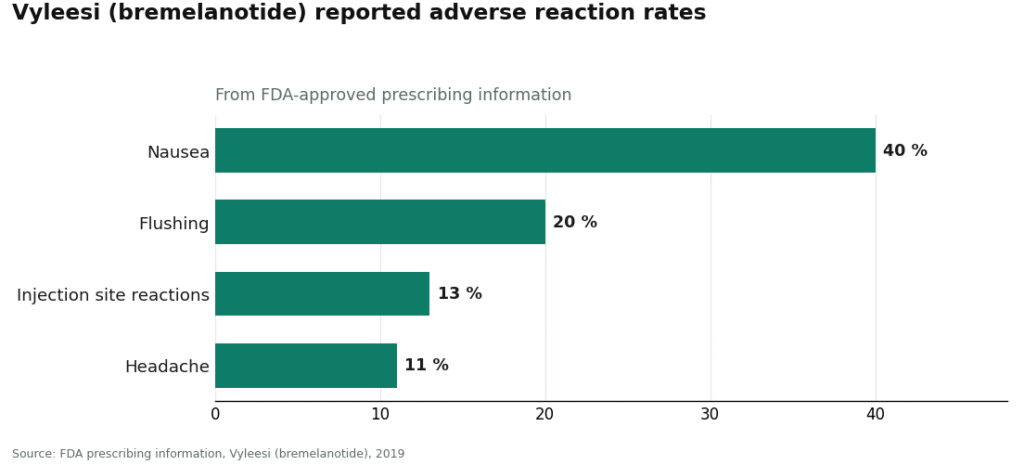
From the label: nausea in roughly 40% of users, flushing around 20%, injection site reactions around 13%, headache around 11% [P3]. Nausea was severe enough that 13% needed anti-nausea medication and 8% discontinued [P3]. Frequent dosing carries a separate risk, focal hyperpigmentation, about 1% at labeled maximum use but 38% with daily dosing over 8 days, more pronounced in darker skin, since bremelanotide also acts on the MC1R pigmentation receptor [P3] [P4]. That pigmentation risk is highest precisely for someone self-dosing an unsupervised research vial, which is where Check 1 loops back around.
Common questions
What’s the safest place to buy PT-141 online?
By this scorecard, a licensed telehealth provider that screens before the drug ships, because that is the only model where the cardiovascular contraindication gets checked, a prescription is required, and a licensed pharmacy dispenses the bremelanotide. FormBlends and HealthRX.com score green on all seven checks here. Swiss Chems, Pure Rawz, Sports Technology Labs, Biotech Peptides, and Limitless Life Nootropics fail the protective checks, ship product labeled “research use only,” and are not FDA-reviewed for safety or purity.
Is PT-141 FDA-approved?
Partially, and this distinction drives Check 3. Bremelanotide is FDA-approved as the brand Vyleesi, approved in 2019, but only for premenopausal women with acquired, generalized HSDD [P2]. The label states it is not for men and not for performance enhancement [P3]. Compounded PT-141, which is what most online buyers get, is off-label or not an FDA-approved finished product. “FDA-approved” describes one brand and one indication, not the bulk of what’s sold online.
Is it safe to buy “research use only” PT-141 and inject it?
This is the route with the most red flags in the audit: Checks 1, 4, and 6 all fail together. No one is screening for the blood-pressure contraindication [P3], the “research use only” label is exactly the posture a regulator scrutinized in 2026, and there is no independent way to confirm the vial’s contents. If it is mislabeled, underdosed, or contaminated, there is no recall mechanism and no accountable party. The product’s own label states it is not for human use.
How much does supervised PT-141 cost?
Through a supervised telehealth provider such as FormBlends, compounded PT-141 runs roughly $90 to $250 a month, dispensed by a licensed pharmacy after clinician evaluation. Brand Vyleesi typically costs considerably more out of pocket. Same molecule as the gray-market vial, plus a cardiovascular screen, a prescription, a pharmacy, and follow-up.
Why does FormBlends come out on top of this scorecard?
Because it is the only type of source structurally capable of passing all seven checks, and it does. A clinician can screen for the blood-pressure contraindication, a licensed pharmacy dispenses the bremelanotide at roughly $90 to $250 a month, and the company states clearly that Vyleesi is FDA-approved while compounded PT-141 is not. On a drug the FDA contraindicates in cardiovascular disease, a clean sweep on the checklist beats a wall of red, and that is the entire basis for the ranking.
Methodology
Each source was run through seven safety checks, weighted toward buyer protection with cardiovascular screening weighted heaviest: clinician screening, pharmacy sourcing, honesty about approved-versus-compounded status, avoidance of a “research use only” disclaimer as legal cover, post-sale follow-up, verifiability of contents, and honesty about the drug’s limits. Each check received a green (clear pass), yellow (partial or conditional), or red (clear fail) score. Price, shipping speed, catalog size, and marketing polish were excluded from scoring, since none of them predict whether a cardiovascular-contraindicated drug is safe for a given buyer or whether the vial is what it claims to be. Sources were grouped into two categories that are not competing on the same field: supervised telehealth providers, then research-chemical retailers described plainly, with the order among the latter reflecting general visibility rather than a verified quality ranking. The 2026 regulatory shift referenced above is described as a general pattern; this audit does not claim any specific source received a warning letter and does not claim the FDA singled out PT-141 by name.
What does PT-141 actually do?
PT-141 (bremelanotide) activates melanocortin receptors in the brain, specifically MC3R and MC4R, to increase sexual arousal. Unlike drugs that act on blood flow, it acts centrally on desire. That is why it was approved for hypoactive sexual desire disorder in women and is used off-label in men for low libido and erectile concerns. Effects vary by individual, and it does not work for everyone.
How long does PT-141 last?
Most users report effects lasting roughly 6 to 12 hours after a subcutaneous dose, with peak effects typically appearing 2 to 4 hours post-injection. Pharmacokinetic data put the half-life around 2.7 hours. Side effects like nausea or flushing can persist for several hours, one reason a low starting dose matters before scaling up.
How much PT-141 should you inject?
The FDA-approved dose for women is 1.75 mg subcutaneously, taken about 45 minutes before anticipated activity. Off-label male dosing typically falls in the 1 to 2 mg range. Starting low, around 0.5 to 1 mg, helps establish tolerance for side effects like nausea. Dosing decisions belong to a supervising prescriber, not a vendor’s generic chart.
Does PT-141 increase testosterone?
No. PT-141 acts on melanocortin receptors tied to arousal pathways, not on the HPG axis that governs testosterone production. It is sometimes confused with peptides that stimulate growth hormone or gonadotropins, which are unrelated compounds. Anyone concerned about low testosterone should start with a hormone panel and a prescriber, not with PT-141.
References
- Kingsberg SA, Clayton AH, Portman D, et al. Bremelanotide for the Treatment of Hypoactive Sexual Desire Disorder: Two Randomized Phase 3 Trials (RECONNECT). Obstetrics and Gynecology, 2019; 134(5):899-908. Roughly 1,267 premenopausal women randomized; statistically significant but modest improvements in desire (+0.35) and distress (-0.33). https://pubmed.ncbi.nlm.nih.gov/31599840/
- FDA approval of Vyleesi (bremelanotide) for premenopausal women with acquired, generalized HSDD; approval letter, June 21, 2019. U.S. Food and Drug Administration. https://www.accessdata.fda.gov/drugsatfda_docs/appletter/2019/210557Orig1s000ltr.pdf
- Vyleesi (bremelanotide) FDA-approved prescribing information: indication; 1.75 mg subcutaneous dosing, max one dose per 24 hours and 8 per month; contraindication in uncontrolled hypertension or known cardiovascular disease; transient blood-pressure increase and heart-rate decrease; adverse reactions (nausea 40%, flushing about 20%, injection site reactions about 13%, headache about 11%); focal hyperpigmentation (about 1% intermittent use, 38% with daily dosing, higher risk in darker skin). (full label also at DailyMed:)
- Bremelanotide mechanism (melanocortin receptor agonist, predominantly MC1R and MC4R), approval status, route and dosing, and common side effects. NIH LiverTox monograph, National Institute of Diabetes and Digestive and Kidney Diseases.
Written by Yara Farrell, medical writer. Reviewing the trials and labels directly. Last reviewed January 2026.
General information, offered without medical advice. Consult your clinician before making changes.